German Shepherd Breed Guide
On this page · 11 sections
You see another dog approaching on the sidewalk and your stomach clenches. You shorten the leash. Your Shepherd spots the dog and erupts. Lunging, barking, spinning at the end of the leash. The other owner gives you a look. You muscle your dog past, embarrassed and exhausted, already dreading the next walk.
Leash reactivity is one of the most stressful problems Shepherd owners face. It makes walks miserable, limits where you can go, and can feel like your dog is aggressive when, in most cases, something else entirely is driving the behavior.
What Leash Reactivity Actually Is
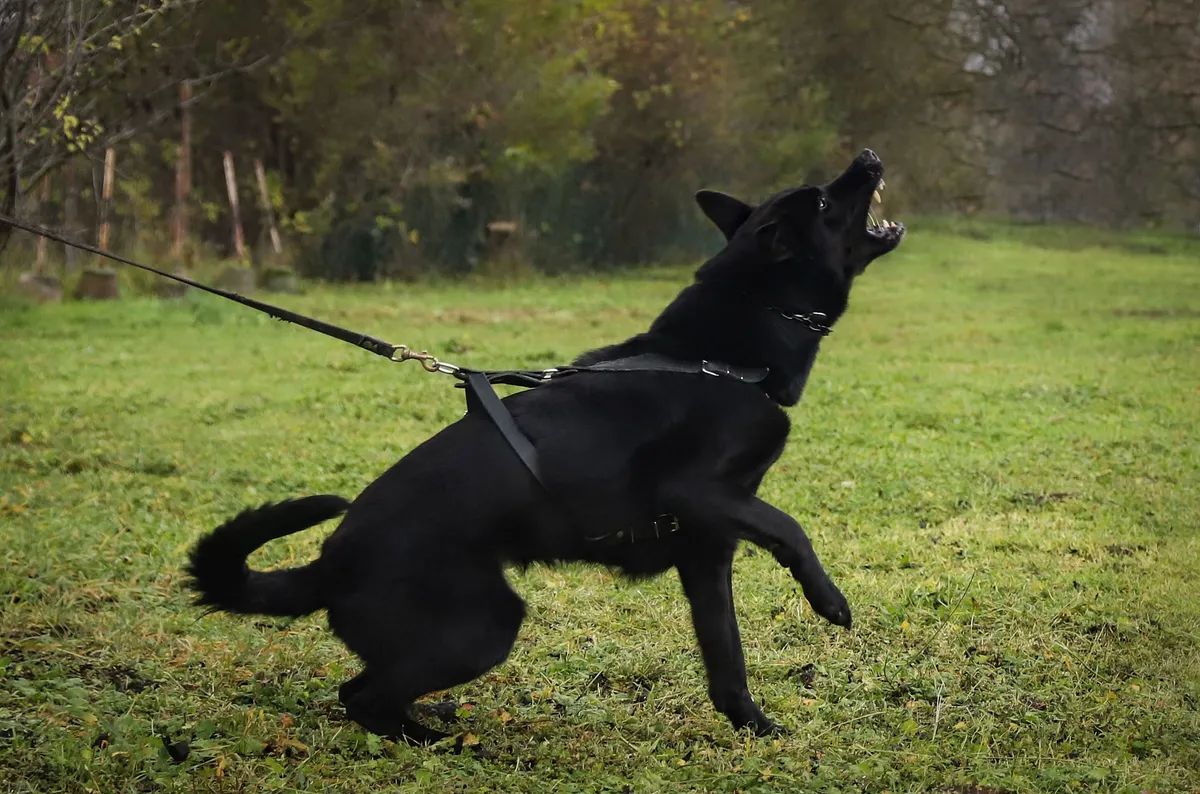
Reactivity is an over-the-top response to a stimulus. The dog sees another dog, a person, a bicycle, or a skateboard and goes from zero to explosive. Barking, lunging, pulling, sometimes spinning or redirecting frustration onto the leash itself.
It looks like aggression to bystanders. And sometimes it is. But in the majority of leash-reactive dogs, the behavior is driven by frustration or fear, not a desire to attack. The distinction matters because it changes how you address it.
The ASPCA’s overview of reactivity describes it as an emotional response, not a calculated one. The dog is not making a decision to be aggressive. It is reacting to an emotional state it cannot control in that moment.
Why Shepherds Are Prone
Several breed traits make leash reactivity more common in Shepherds than in many other breeds.
Alertness and vigilance. The breed notices things other dogs ignore. They are scanning their environment constantly, and their threshold for reacting to a change is lower than average.
Protectiveness. Some Shepherds react on leash because they feel responsible for keeping you safe. Another dog approaching triggers the security system.
Frustration tolerance. Shepherds are high-drive dogs. When they see something interesting and cannot get to it, frustration builds fast. Off-leash, these same dogs often greet and play perfectly well. The leash prevents them from doing what they want, and frustration boils over into what looks like aggression.
Socialization gaps. A Shepherd that missed early socialization or had negative experiences with other dogs during the critical period (3-14 weeks) may react from fear. The leash removes the option to flee, so the dog defaults to the other survival option: making itself look scary. The breed characteristics overview puts the vigilance and protectiveness drives into the broader temperament picture if you want context on why the breed reacts faster than most.
The Tight-Leash Cycle
This is the mechanism that makes reactivity worse over time, and most owners participate in it without realizing.
Here is how it works:
- You see another dog approaching. Your body tenses. You shorten the leash.
- Your dog feels the leash tighten and reads your tension through the leash and your body language.
- The dog concludes: this situation is dangerous. My person is worried. I should be worried too.
- The dog reacts. You pull harder. The dog pulls harder. Arousal escalates.
- The other dog passes. The tension releases. The dog learns that the explosion made the scary thing go away.
Every repetition of this cycle reinforces the reactive behavior. The dog practices reacting, gets good at it, and starts reacting earlier and more intensely over time.
A widely taught reactive-dog principle: the leash is a communication channel. When a handler tightens it in anticipation of a reaction, many dogs read that sudden tension, paired with the handler’s stiffening body language, as confirmation that the approaching trigger is a threat.
— Training principle consistent with the AVSAB position against confrontational, aversive handling
Frustration-Based vs. Fear-Based Reactivity
The two types look similar from the outside but have different emotional roots, and the fix differs accordingly.
Reading the difference between frustration and fear reactivity
| Signal | Frustration-based | Fear-based |
|---|---|---|
| Body posture | Forward, weight over front, leaning into the leash | Weight shifted back, sometimes crouched or trying to retreat |
| Bark / vocal | Lower-pitched, sometimes mixed with whining | Higher-pitched, sharper, more staccato |
| Tail and ears | Tail high, ears forward and alert | Tail tucked or stiff-low, ears flat or rotating |
| Off-leash with same dog | Often friendly, plays normally | Still avoidant or defensive; fear does not lift with the leash |
| Primary fix | Lower arousal, teach impulse control, reward calm passes | Build positive association at distance, never flood |
Some dogs have elements of both. A trainer or behaviorist can help you read your dog’s body language accurately. If the same dog is also jumping on every guest who walks in the door, the same impulse-control work shows up in the jumping protocol.
What You Can Do Today
Increase Distance
Distance is your best friend. The farther your dog is from the trigger, the easier it is for them to stay under threshold. Find the distance at which your dog notices the other dog but does not react. That is your starting point.
If you need to cross the street, turn around, or duck behind a parked car to maintain that distance, do it. There is no shame in managing the situation. Every time your dog reacts, the behavior gets reinforced. Every time they do not react, you have a chance to reward calm behavior.
Counter-Conditioning
The goal is to change your dog’s emotional response to the trigger. Instead of “other dog = scary/frustrating,” you want “other dog = good things happen.”
At a distance where your dog can notice another dog without reacting, start feeding high-value treats. Continuously. The other dog appears, the treats appear. The other dog leaves, the treats stop. Repeat.
Over sessions, the dog starts to associate the sight of other dogs with something positive. The emotional response shifts. This takes time, typically weeks or months, not days.
The AKC’s guide to reactive dogs outlines this process and emphasizes the importance of keeping the dog below threshold during training.
Engage-Disengage Protocol
This is a structured version of counter-conditioning.
Engage: The dog looks at the trigger. You mark the moment (“yes”) and reward.
Disengage: Over time, the dog starts looking at the trigger and then looking back at you voluntarily. Mark and reward that choice.
The dog learns: I see the thing, I look at my person, I get a reward. The trigger becomes a cue for checking in rather than a cue for exploding. This protocol was developed by behavior professionals and is widely used in reactive dog programs.
Equipment
A front-clip harness reduces pulling leverage and gives you more control during reactive episodes. The leash attaches to the dog’s chest, so forward lunging redirects the dog sideways rather than allowing them to pull you forward.
A standard 6-foot leash provides enough slack for normal walking without giving so much length that you lose control. Avoid retractable leashes entirely. They provide inconsistent tension and zero control during a reactive episode.
Manage Your Own Body
This is harder than it sounds. When you see a trigger approaching, your instinct is to tighten up. Shorten the leash, hold your breath, brace. Your dog reads every bit of that.
Practice keeping the leash loose, your breathing steady, and your body relaxed. If you cannot maintain this, increase your distance from the trigger until you can. Your calm is contagious.
Your Actual Walk Protocol
Theory is useful. But what does this look like in practice when you are walking an 80-pound reactive Shepherd on a Tuesday evening?
Before you leave: Exercise the dog first. A 10-minute fetch session or training drill in the yard takes the edge off. A wired dog with fresh energy has a shorter fuse. Chronically under-exercised Shepherds run a hotter baseline arousal across the board, which is one reason the pros-and-cons primer flags this breed as a poor fit for low-activity households.
Choose your route deliberately. Walk at times and in locations where encounters are manageable. Early morning, quiet streets, wide paths. Avoid the dog park perimeter, narrow sidewalks, and the busy post-work hour. This is not avoidance. It is setting the dog up to succeed.
Scan ahead constantly. Your job is to see triggers before your dog does. When you spot another dog, assess the distance. If it is within your dog’s threshold, create space: cross the street, turn around, step off the path behind a parked car.
When a trigger appears at a safe distance: Start feeding treats. Keep your leash loose. Talk to your dog in a calm, upbeat voice. If the dog looks at the trigger and then looks back at you, that is the engage-disengage in action. Reward it heavily.
If the dog reacts despite distance: Do not panic. Turn and walk the other direction. Get distance. Do not drag the dog. Walk briskly and let the leash create gentle pressure. Once you have enough distance, let the dog reset. Then resume.
When another owner approaches head-on: “My dog needs space” is a complete sentence. Say it early, say it clearly, and move off the path. Do not apologize for managing your dog. You are being responsible.
When your spouse or partner walks the dog: A front-clip harness and a shorter route with fewer triggers make walks manageable for someone with less physical strength. Both handlers should use the same verbal cues and the same distance thresholds. Inconsistency between handlers confuses the dog.
What Does NOT Work
Leash corrections. Jerking the leash when the dog reacts adds pain or discomfort to an already emotional moment. The dog may associate the pain with the other dog, making the reactivity worse. “That dog appeared and something hurt me” is not the association you want.
Forcing the dog to meet triggers. Walking your reactive dog into a situation where they must face their trigger at close range is flooding, not training. It can create severe setbacks.
Punishment. Yelling, shock collars, or physical corrections during reactive episodes increase the dog’s arousal and stress without teaching an alternative behavior.
When It Is Not a DIY Project
Some reactive dogs respond well to the approaches above. Others need professional help. Seek a certified trainer or veterinary behaviorist if:
- Your dog’s reactivity is intense (cannot redirect even at significant distance, snapping, redirecting aggression onto you or the leash)
- The behavior has escalated over time despite your efforts
- You feel unsafe walking your dog
- The reactivity includes aggression toward people, not just dogs
- Your dog has bitten another dog or person during a reactive episode
A professional can develop a structured desensitization plan, evaluate whether medication might help lower baseline arousal, and coach you through the mechanical skills of reactive dog handling. The cost of behavioral work is an investment in your dog’s quality of life and yours.
Reactivity Is Not Aggression
Most leash-reactive dogs are not aggressive. They are emotional dogs having big reactions in a constrained situation. Many reactive Shepherds play beautifully off-leash with dogs they know, adore their families, and are gentle in every other context. The body-language table above is the cleanest first filter. Fear-based reactivity carries different risk than frustration and warrants a different plan. If the body language is closer to closing-distance than create-distance, the aggression guide covers what genuinely warrants a behaviorist referral instead of a desensitization plan.
The prognosis for reactivity is usually good with consistent work. Some dogs never become perfectly calm when passing other dogs, but they can learn to manage themselves well enough that walks become enjoyable again.
Related Behavior Guides
Leash reactivity sits inside a wider cluster of arousal and fear patterns. The most useful sibling guides:
- Reactive vs aggressive — body-language matrix — the diagnostic decision tree for telling these apart.
- Aggression overview — when the body language is committed-forward rather than create-distance.
- Fearful Shepherd — fear is the most common root cause of reactivity; the confidence-building protocol overlaps directly.
- Overprotective of owner — when the leash reactivity is specifically aimed at people approaching you.
- Noise phobia — fireworks/storm sensitization elevates baseline reactivity for days.
Sources
Reactivity-research figures and protocol guidance on this page are sourced as follows. Last verified 2026-05-22.
- Herron ME, Shofer FS, Reisner IR. Survey of the use and outcome of confrontational and non-confrontational training methods in client-owned dogs showing undesired behaviors. Applied Animal Behavior Science 2009;117(1-2):47-54. ScienceDirect. Source of the 25-43% aggression-response figure cited in the By-the-Numbers callout.
- American Veterinary Society of Animal Behavior. Position Statement on the Use of Punishment for Behavior Modification in Animals. avsab.org. Standard-of-care position against confrontational training.
- ASPCA. Common Dog Behavior Issues: Reactivity. aspca.org. Reactivity as an emotional, not calculated, response.
- American Kennel Club. Reactivity vs. Aggression in Dogs. akc.org. Counter-conditioning protocol below-threshold.
- American College of Veterinary Behaviorists. Find a Veterinary Behaviorist. dacvb.org. Board-certified behavior referral directory.
- O’Neill DG, Coulson NR, Church DB, Brodbelt DC. Demography and disorders of German Shepherd Dogs under primary veterinary care in the UK. Canine Genetics and Epidemiology 2017;4:7. PMC5532765. Breed-level prevalence baseline.
- Bamberger M, Houpt KA. Signalment factors, comorbidity, and trends in behavior diagnoses in dogs: 1,644 cases (1991-2001). JAVMA 2006;229(10):1591-1601. PubMed. Behavior-clinic case distribution context.
- Casey RA, Loftus B, Bolster C, Richards GJ, Blackwell EJ. Inter-dog aggression in a UK owner survey: prevalence, contexts and risk factors. Veterinary Record 2013;172(5):127. PMC. Owner-reported reactivity prevalence patterns.
Owner-experience anchors and walk-protocol detail reflect Sam’s records across four Shepherds (per agent-os/22-sams-dogs-reference.md).
Follow new work
A new guide every week or so.
Roughly one new guide every week or so. Cost data, feeding research, breed health — sourced and dated. By Sam, in Belgium.
Related Articles
German Shepherd Separation Anxiety — Signs and Solutions
Why German Shepherds get separation anxiety and how to fix it. Covers signs, severity levels, a step-by-step protocol, and a schedule for working owners.
How to Find a Good Vet for Your German Shepherd
How to find a vet who knows German Shepherds: what to look for, what to ask, the specialists that matter, and how to prepare for bloat before it happens.

First-Time German Shepherd Owner Mistakes to Avoid
Experienced German Shepherd owners share the costly mistakes they wish they had avoided. Covers socialization, exercise, feeding, budgeting, and shedding.