German Shepherd Breed Guide
One of the most common questions from people considering a German Shepherd is whether to get a male or a female. It is a reasonable question, and the answer is less dramatic than many breed guides suggest.
There are real differences. Males are larger. Females mature faster. Certain behavioral tendencies lean one way or the other. But individual variation within each sex is enormous, and the dog’s breeding, socialization, and training will shape its personality far more than its sex alone.
Here is what actually differs and what does not.
Size and Physical Differences
This is the most clear-cut difference. Males are noticeably larger. The AKC breed standard sets the ranges; in practice well-bred adults land near the middle.
| Measure | Male | Female | Practical impact |
|---|---|---|---|
| Height at shoulder | 24-26 in | 22-24 in | Crate, gate, and vehicle space |
| Weight | 65-90 lb | 50-70 lb | Lifetime food cost, leash handling |
| Head and frame | Broader, thicker neck | More refined | Harness sizing, vet table comfort |
| Coat density | Slightly heavier ruff | Slightly lighter ruff | Shedding volume similar in both |
| Bite force / pull strength | Higher absolute | Slightly lower | Leash handling for smaller handlers |
A large male can outweigh a small female by 30 pounds. For smaller handlers, households with young children, or anyone who values manageable size, a female is often the easier dog to live with on a day-to-day basis.
Temperament Tendencies
Individual variation matters more than generalizations. Still, experienced breeders and trainers report some broad patterns, and the 2017 O’Neill et al. study of 1,660 UK Shepherds put numbers on a couple of them.
Males tend to:
- Be more overtly territorial and protective of their home and property
- Display more dominant behaviors, particularly around other male dogs
- Be more physically playful and sometimes more boisterous
- Take longer to mature emotionally (some males act like puppies well into their second year)
- Bond strongly but sometimes spread their attention across the whole family
Females tend to:
- Mature faster, both physically and behaviorally
- Be more focused during training sessions
- Show strong protective instincts directed particularly toward children
- Be more independent at times, with a slightly lower need for constant attention
- Display less same-sex aggression than males (though it still occurs)
The same study recorded another quiet sex difference: females outlived males, with a median longevity of 11.1 years versus 9.7 (P=0.001). It is not a reason to choose one sex over the other, but it is a real pattern in the data rather than folklore.
Aggression was recorded in 6.75% of male German Shepherds compared with 2.78% of females (P<0.001), ranking as the fifth most common disorder in the breed.
— Finding from O’Neill et al., Canine Genetics and Epidemiology (2017)
A note on what that figure is and is not: the study logged “aggression” as a single category from primary-care records. It does not separate aggression toward people from aggression toward other dogs, and it does not isolate neuter status. So it tells you males are flagged for aggression about twice as often, not why. These are tendencies, not rules. A calm, focused male and a high-energy, boisterous female are both perfectly normal. Breeding lines and individual genetics have far more influence on temperament than sex. A Shepherd from working lines will behave differently from one from show lines regardless of whether it is male or female.
How Trainability Differs Between Sexes
Both sexes are highly trainable. The breed consistently ranks in the top three for working intelligence, and that applies across the board.
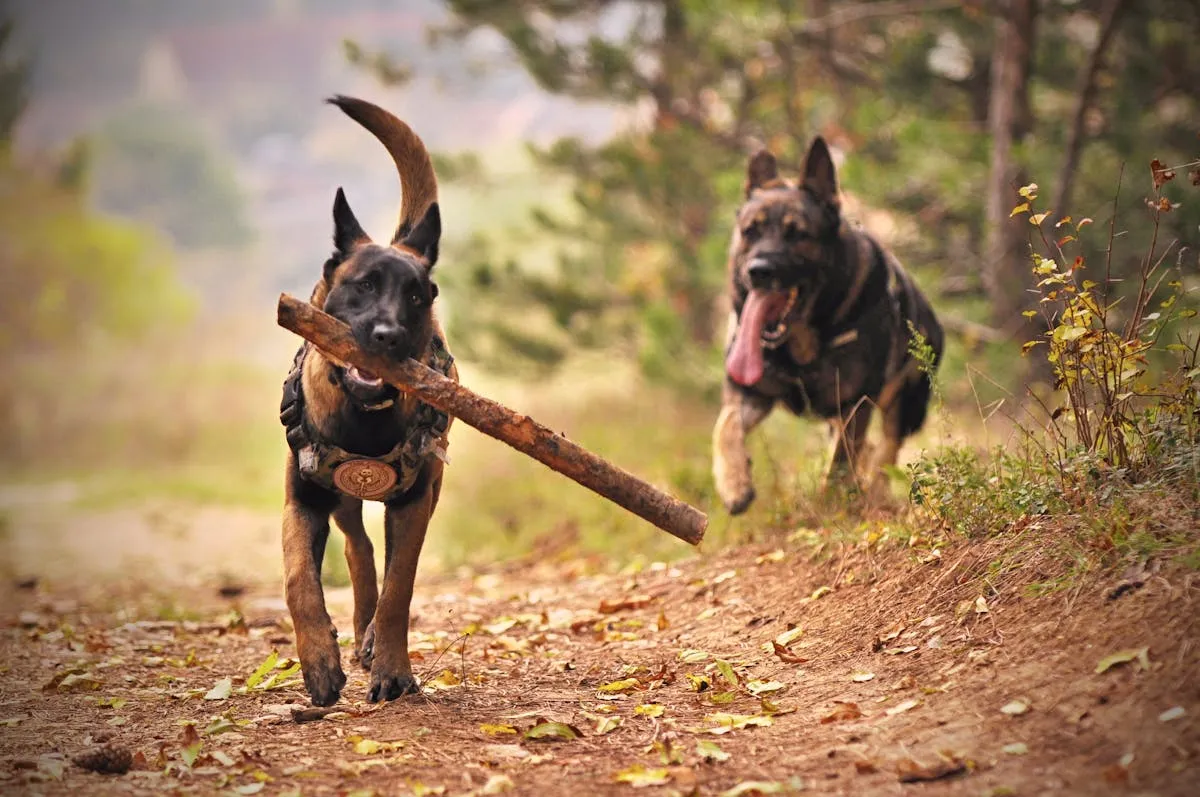
The common claim that females are “easier to train” has some basis. Females often mature faster and can focus sooner during training sessions, particularly in the adolescent phase. Males in that same adolescent phase (roughly 6 to 18 months) may be more easily distracted, more prone to testing boundaries, and more physically exuberant during training.
In professional working roles, both sexes perform at the highest levels. Police departments, military units, and service dog organizations use both males and females. The selection criteria focus on individual drive, nerve, and temperament, not sex.
For a first-time owner, a female may provide a slightly smoother training experience during the adolescent months. But the difference is not large enough to make sex the primary selection criterion. Training consistency and quality matter far more than the dog’s sex.
Maturity Timeline
Females typically reach physical maturity around 18 to 24 months. Males often take 24 to 36 months to fully fill out and settle into their adult temperament.
This matters for several reasons:
- Training expectations. A male that still acts like a teenager at 20 months is not broken. He is developing on schedule. Patience helps.
- Exercise management. Growth plates in larger males may take longer to close, which affects what types of exercise are safe during development. High-impact activities like jumping and running on hard surfaces should be limited until growth plates close. Your vet can advise on timing.
- Behavioral settling. The adolescent phase in males can be more prolonged and more challenging. Consistent training through this period is essential.
Spaying and Neutering Considerations
Timing of spay or neuter surgery is a topic of ongoing research and veterinary discussion. Current evidence suggests that early spaying or neutering (before one year) in large breeds may increase the risk of certain joint disorders and some cancers.
The most-cited evidence here is German Shepherd specific. A UC Davis study of 1,170 Shepherds (Hart et al., 2016) found that joint disorders roughly tripled in males neutered before 6 months: 7% in intact males versus 21% in those neutered early. Females showed a similar spike, peaking near 17% when spayed between 6 and 11 months against a 5% intact baseline. In both sexes, the elevated risk faded for dogs altered after a year. The follow-up 35-breed analysis (Hart et al., 2020) carried the same conclusion into a general guideline: for German Shepherds of either sex, delaying neutering until at least 12 months is the lower-risk default.
This is an area where veterinary guidance is essential. These are observational associations, not proof that early neutering causes joint disease, and the right timing depends on the individual dog’s health, living situation, and risk factors. Discuss it with your vet rather than relying on generalized advice.
For male and female German Shepherds, joint-disorder rates were highest in dogs neutered before a year of age; delaying gonadectomy beyond 12 months is advisable.
— Finding from Hart et al., UC Davis (2016, 2020)
Living With Multiple Dogs
If you already have a dog and are adding a Shepherd, sex matters more. Same-sex pairings (particularly two males) are more likely to produce conflict than opposite-sex pairings. This is not unique to Shepherds, but the breed’s strong personality and territorial nature can amplify it.
Opposite-sex pairings tend to coexist more easily. Two females can work well together, though female-female aggression does occur. Two males require more careful management and sometimes never fully settle into a peaceful dynamic.
If you are getting your first dog, this consideration is less relevant. But it is worth thinking about if a second dog is in your future plans.
Cost Differences
The cost difference between males and females is generally small but not zero:
- Purchase price. Some breeders charge the same for both sexes. Others charge slightly more for females, particularly in show and working lines where breeding rights add value.
- Food costs. Males eat more due to their larger size. Over a lifetime, this adds up. Size the portions in the feeding calculator, or see our feeding guide for detailed feeding recommendations.
- Veterinary costs. Spay surgery is typically more expensive than neuter surgery because it is a more involved procedure. Otherwise, routine veterinary costs are comparable.
- Equipment. Larger crates, beds, and harnesses for males cost slightly more.
For a comprehensive breakdown of ownership costs, see our cost guide, and if you are still working out whether the breed fits your life at all, the pros-and-cons primer and is a German Shepherd right for me? decision pieces lay out the trade-offs before sex selection even matters. If you are choosing between the breed and a Belgian Malinois entirely, the German Shepherd vs Malinois comparison is the next stop.
Decision Flow: Which Sex Fits Your Household
If you only have time for one sanity check before talking to the breeder, walk through this in order. Most owners who get sex selection wrong are skipping step 1 or step 4.
Walk through in order. Most owners who get sex selection wrong skip step 1 or step 4.
- Q1 Already have another dog in the home?
- Yes Pick the OPPOSITE sex of your existing dog.Two intact males together is the highest-conflict pairing (O'Neill 2017). Two females can also conflict; opposite-sex is the lowest-risk default.
- No Continue to Q2.
- Yes
- Q2 Is the primary handler smaller-framed or new to large breeds?
- Yes Lean FEMALE.Females run 50–70 lb vs males at 65–90 lb — meaningfully easier on the leash for handlers under ~140 lb.
- No Continue to Q3.
- Yes
- Q3 Can you commit to a longer adolescence (24–36 months to settle) with consistent training?
- Yes Either sex works — choose MALE if you want the bigger frame and more overt territoriality.
- No Lean FEMALE.Females typically settle by 18–24 months and are less boisterous through the 6–18 month teenage phase.
- Yes
Which Is Better for Your Household
There is no universally “better” sex. The right choice depends on your specific situation:
A male may be a better fit if:
- You want a larger, more physically imposing dog
- You enjoy active play and can handle a more boisterous adolescent phase
- You do not have another male dog at home
- You want a dog that may be more overtly protective of the property
A female may be a better fit if:
- You prefer a more moderately sized dog
- You want a dog that may mature and settle slightly faster
- You have young children and want a dog that reaches reliable behavior sooner
- You already have a male dog and want to reduce the risk of same-sex conflict
For either sex, what matters most:
- The breeder’s reputation and the quality of the breeding pair
- Early socialization and consistent training
- Adequate exercise and mental stimulation
- A household that has time for a high-engagement breed
The individual dog’s personality will always matter more than its sex. A well-bred, well-socialized Shepherd of either sex makes an outstanding companion. Focus on finding a reputable breeder with health-tested parents and temperaments you admire. The sex is secondary to all of that.
Sources
- American Kennel Club. German Shepherd Dog Breed Standard. Height and weight ranges.
- O’Neill DG, Coulson NR, Church DB, Brodbelt DC (2017). “Demography and disorders of German Shepherd Dogs under primary veterinary care in the UK.” Canine Genetics and Epidemiology, 4:7. Full text. Sex-split aggression (6.75% vs 2.78%) and longevity (11.1 vs 9.7 yr), random sample n=1,660.
- Hart BL, Hart LA, Thigpen AP, Willits NH (2016). “Neutering of German Shepherd Dogs: associated joint disorders, cancers and urinary incontinence.” Veterinary Medicine and Science, 2(3):191–199. Full text. GSD-specific joint-disorder rates by neuter age, n=1,170.
- Hart BL, Hart LA, Thigpen AP, Willits NH (2020). “Assisting decision-making on age of neutering for 35 breeds of dogs.” Frontiers in Veterinary Science, 7:388. Full text. The revised “delay beyond 12 months” guideline.
- Coren S (2006). The Intelligence of Dogs. Bantam. German Shepherd ranking among working intelligence top three.
- American Veterinary Medical Association. Elective Spaying and Neutering of Pets. Current consensus on timing.
- Merck Veterinary Manual. Behavior Problems in Dogs. Same-sex aggression context.
Follow new work
A new guide every week or so.
Roughly one new guide every week or so. Cost data, feeding research, breed health — sourced and dated. By Sam, in Belgium.
Related Articles
German Shepherd Breed Characteristics
Complete guide to German Shepherd breed characteristics: AKC size standards, temperament, intelligence ranking, coat types, health, and family suitability.
German Shepherd Temperament and Personality
What German Shepherds are like to live with — loyalty, vigilance, intelligence, energy, and how temperament differs across working and show lines.

Is a German Shepherd Right for Me
Honest look at whether a German Shepherd fits your lifestyle, budget, and living situation. Exercise needs, monthly costs, health risks, and housing realities.